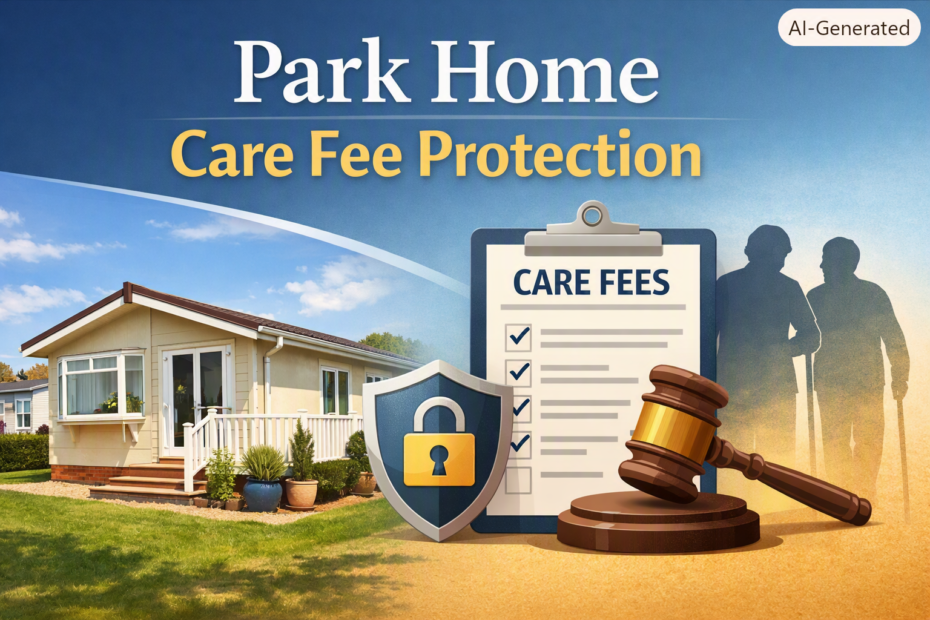
For years, homeowners have asked whether they can protect their property from possible future care fees by placing it into a trust. But what happens when the property isn’t a traditional bricks‑and‑mortar house — it’s a park home?
This article explains how park homes are treated by local authorities, whether they can be placed into a trust, and when a trust might be accepted as legitimate.
Are Park Homes Treated as “Homes” for Care‑Fee Assessments?
Yes. If a park home is your main residence and you own the home itself, local authorities treat it the same as any other residential property when assessing your ability to pay for care.
That means:
🛡️ Worried About Losing Your Home to Care Fees?
Many UK homeowners don’t realise their property can be used to pay for care fees. Get free advice before a crisis hits and protect what you’ve worked your whole life for.
Request Your Free Estate Planning ReviewIt has a market value
It can be counted as capital
It can be subject to property disregard rules
It can be subject to deprivation‑of‑assets rules
The fact that it’s a park home rather than a traditional house doesn’t change how the Care Act 2014 applies.
Can You Put a Park Home Into a Trust?
Yes — legally, you can place a park home into a trust. Solicitors can draft a trust for a park home just as they would for a standard property.
But the crucial question is not “Can I?” It’s “Will the council accept it?”
And that depends entirely on your intention at the time the trust was created.
The Key Test: Was Care Foreseeable at the Time?
Local authorities don’t look at the legal structure — they look at why the home was put into a trust.
If the trust was created:
Many years before any care need
When you were in good health
With no GP notes suggesting declining health
With no care assessments or care discussions
For normal estate‑planning reasons (inheritance, remarriage protection, family planning)
…then the council is far more likely to accept the trust as legitimate.
In this situation, the trust was not created to avoid care fees, and therefore is not deprivation of assets.
When a Trust Will NOT Be Accepted
Even if the trust was created years ago, the council may still treat it as deprivation if:
You already had long‑term health conditions
You were already receiving care at home
You had mobility issues or daily‑living difficulties
You had been advised you may need care
The trust paperwork mentions care fees or “protecting the home”
Councils look at foreseeability, not the number of years that have passed.
If care was reasonably predictable at the time, the trust can be ignored.
Park Homes: A Non‑Obvious Advantage
Park homes often have lower market value than traditional houses. This means some owners remain below the £23,250 capital threshold, even without a trust.
In many cases, the issue isn’t “protecting the home” — it’s simply understanding how its value affects the assessment.
So, Can a Park Home in a Trust Be Safe From Care Fees?
Yes — but only if the trust was created long before care was foreseeable, and for reasons unrelated to care fees.
If the trust was created:
Early
In good health
For normal estate‑planning reasons
…it may stand.
If it was created:
Late
After health decline
With care fees in mind
…it will almost certainly be challenged.
Need Help Understanding Your Options?
If you own a park home and want to understand your position, our helpline can explain:
How park homes are valued
How trusts are assessed
What councils look for
What is and isn’t allowed under deprivation‑of‑assets rules
You can also request our free guide on care‑fee planning.
Most Families Don’t Find This Out Until It’s Too Late
When a parent first needs care, most families assume one...
Read MorePaying for Elderly Care in the UK: What Every Homeowner Needs to Know

Planning for later life is not something most people enjoy...
Read MoreCan the Council Take My House to Pay for Care Fees?
Many UK homeowners are now asking can the council take...
Read More1 British Elderly Homeowner Loses Their Home Every 7 Seconds
Across the UK, elderly homeowners losing their homes to care...
Read MoreUK Budget 2025: What It Means for Care Fees – And Why Costs Could Rise Again
The latest UK Budget has raised serious concerns for older...
Read MoreCalls for the Government to Stop Hiding Facts That Are Costing People Their Homes

For decades, British families have been told that owning a...
Read More