
Skip to content
Home » News » The Care Fee Cap That Never Arrived: A Timeline of England’s Social Care Promises

The Care Fee Cap That Never Arrived: A Timeline of England’s Social Care Promises

  • by
Care Cap

If you’ve been following the news about care home fees, social care reform, or protecting your home from care costs, you may have noticed that governments have been promising change for many years.

Most recently, Prime Minister Andy Burnham has said that reforming England’s social care system is one of his priorities.

However, this is far from the first time that politicians have pledged to change the way long-term care is funded.

Here’s a look at the history of the proposed care fee cap, what happened to it, and where things stand today.

🛡️ Worried About Losing Your Home to Care Fees?

Many UK homeowners don’t realise their property can be used to pay for care fees. Get free advice before a crisis hits and protect what you’ve worked your whole life for.

Request Your Free Estate Planning Review

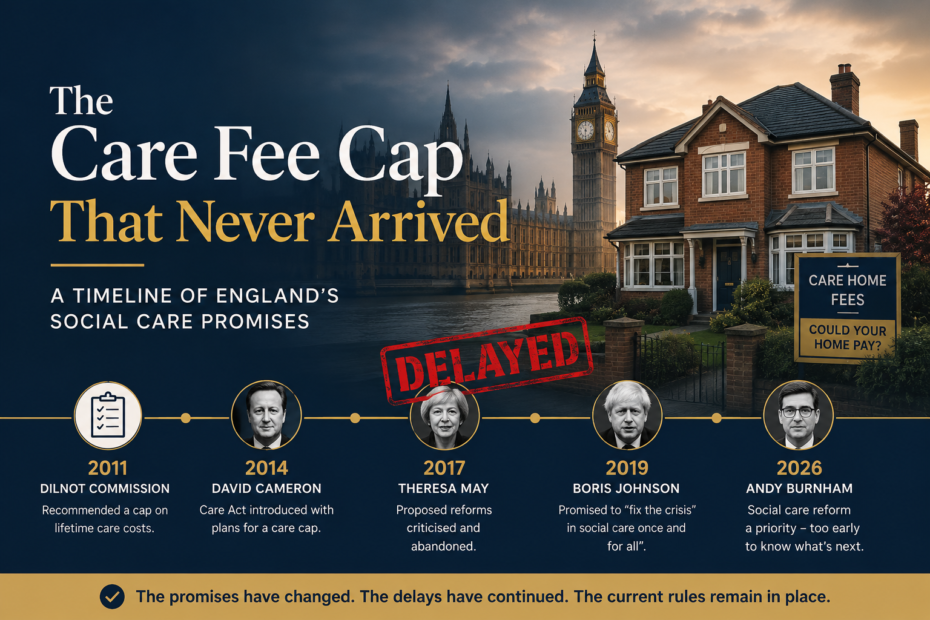
The Dilnot Commission (2011)

In 2011, the independent Dilnot Commission recommended introducing a cap on lifetime care costs.

The aim was simple.

Instead of people potentially paying unlimited amounts for their personal care, there would be a maximum amount an individual would have to contribute during their lifetime.

The proposal was widely welcomed by charities, campaign groups and many experts in adult social care.

However, it was only a recommendation and required legislation before it could become law.

David Cameron and the Care Act 2014

The Coalition Government accepted many of the Dilnot recommendations and introduced the Care Act 2014.

The Act included provisions for a care costs cap, originally expected to come into force in April 2016.

Many homeowners believed that, at last, there would be a limit on how much they could be required to pay towards their personal care.

Unfortunately, that never happened.

Before the cap came into force, the Government announced that it would be delayed.

Theresa May and the "Dementia Tax" (2017)

During the 2017 General Election, Prime Minister Theresa May proposed major changes to the way social care would be funded.

The proposals quickly became known in the media as the “Dementia Tax.”

Following significant public criticism, the plans were withdrawn and no long-term replacement was introduced.

Once again, promised reform failed to materialise.

Boris Johnson's Promise to "Fix Social Care"

When Boris Johnson became Prime Minister in 2019, he famously promised to:

Fix the crisis in social care once and for all.

The Government later announced new funding and confirmed that a care costs cap would finally be introduced.

Many homeowners believed the long-awaited reforms were finally on their way.

However, implementation was delayed again before the cap was ultimately abandoned.

Multiple Governments, The Same Outcome

Over the past decade, England has seen several Prime Ministers, numerous Health Secretaries and repeated announcements about social care reform.

Despite years of consultation, White Papers, Green Papers and policy announcements, the proposed cap on care fees has never been implemented.

Today, the rules surrounding care home fees, means-tested social care, and property assessments remain broadly the same as they have for many years.

Andy Burnham's Plans

Since becoming Prime Minister, Andy Burnham has identified social care reform as one of his Government’s priorities.

He has spoken about creating a fairer system and has previously expressed concerns that too many people are forced to use their savings or the value of their home to pay for care.

At the time of writing, no legislation has been introduced to change the current rules.

While reform is once again being discussed, it is too early to know:

  • Whether a care fee cap will return.
  • Whether inheritance tax could be reformed.
  • How any new system would be funded.
  • Which homeowners, if any, would benefit.

What Does This Mean for Homeowners?

The history of social care reform demonstrates that announcing proposals and implementing them are two very different things.

Successive governments have recognised that England’s care funding system needs reform.

However, major changes have repeatedly been delayed, revised or abandoned before becoming law.

For homeowners, this means that the current rules continue to apply unless and until Parliament passes new legislation.

It is sensible to stay informed about any future announcements, but equally important not to assume that proposed reforms will automatically become law.

The Bottom Line

The idea of introducing a cap on care costs has been discussed for well over a decade.

It has appeared in government plans under different Prime Ministers, attracted widespread public attention, and been postponed or withdrawn on more than one occasion.

Now, with Andy Burnham placing social care reform back on the political agenda, the conversation has begun again.

Whether this Government succeeds where previous governments have not remains to be seen.

Over the past decade, governments have repeatedly promised reform, yet the current rules remain in place. Rather than waiting to see what may happen next, many homeowners choose to understand the options available to them today. If you’d like independent guidance on your estate planning options, click the button below to book your free estate planning review.