
When Eddie Winn’s mother died, he thought her wishes were perfectly clear.
Mary had left a Will stating that her estate should be divided equally between her seven children. But what Eddie expected to be a straightforward inheritance soon became a lengthy legal battle, with professional fees and a successful claim by his father leaving the children with considerably less than they had expected.
From Ireland to England
Eddie came from a large family.
His parents, Mary and Dermot, emigrated from Ireland to England in 1949, hoping to build a better life for themselves and their future family.
🛡️ Worried About Losing Your Home to Care Fees?
Many UK homeowners don’t realise their property can be used to pay for care fees. Get free advice before a crisis hits and protect what you’ve worked your whole life for.
Request Your Free Estate Planning ReviewEddie was born in London and grew up alongside his six siblings. As the family grew, they eventually moved to Stevenage, Hertfordshire, as London became increasingly crowded.
Dermot found work locally, while Mary stayed at home looking after their seven children.
For the family, their house became the centre of their lives.
In the 1980s, Mary and Dermot bought their council house through the Right to Buy scheme for around £28,000.
At the time, that was a substantial amount of money for the family.
Nobody could have imagined that decades later, the same property would be worth around £400,000.
A family home worth £400,000
Years later, Mary and Dermot divorced.
Eddie continued living with his mother in the family home.
Mary eventually made a Will setting out what she wanted to happen to her estate.
Her instructions were straightforward: her estate was to be divided equally between her seven children.
Then, in February 2025, Mary sadly passed away.
The family home was now worth approximately £400,000, while Mary had no significant savings.
The family arranged a funeral costing around £7,000, which Eddie and his siblings paid for themselves while they waited for the estate to be dealt with.
Eddie understood that probate could take some time, but nobody expected the process to become the ordeal that followed.
‘It will only cost a few per cent’
The solicitor who had prepared Mary’s Will was a local high-street solicitor.
According to Eddie, the solicitor offered to deal with the probate as well and explained that the fee would be calculated as a percentage of the estate.
At first, the figure didn’t sound particularly alarming.
“One or two per cent doesn’t sound like much when someone says it to you,” Eddie recalled.
But when the main asset is a £400,000 house, percentages can quickly become substantial sums.
The solicitor ultimately charged 3% of the estate, amounting to approximately £12,000.
17 months waiting for probate
The family was also shocked by how long the probate process took.
Probate was finally completed approximately 17 months after Mary’s death.
“This wasn’t a complicated estate,” Eddie said. “There wasn’t a business or a complicated investment portfolio. It was basically the family home.”
The estate also incurred other legal and administration costs.
At one point, the family believed that after the costs had been dealt with, there could be approximately £40,000 to £45,000 available for each of the seven children.
But then another problem emerged.
Dermot challenges the estate
Mary’s former husband, Dermot, challenged the family’s understanding of who was entitled to the property.
Although Mary had left her estate to her seven children, Dermot argued that he had contributed towards purchasing the family home during their marriage and claimed that he retained an interest in the property.
The matter became a legal dispute.
Eventually, Dermot succeeded in establishing a claim against the estate.
The result was that he received a substantial share of the property’s value before the remainder could be divided between Mary’s seven children.
For Eddie and his siblings, it was a devastating development.
They had believed that their mother’s wishes meant the house would ultimately benefit the seven children equally.
Instead, a significant portion of the estate was going elsewhere.
How £400,000 became considerably less
The family had initially looked at the £400,000 property and imagined that, divided equally between seven children, it could potentially provide around £57,000 each before costs.
But the reality was very different.
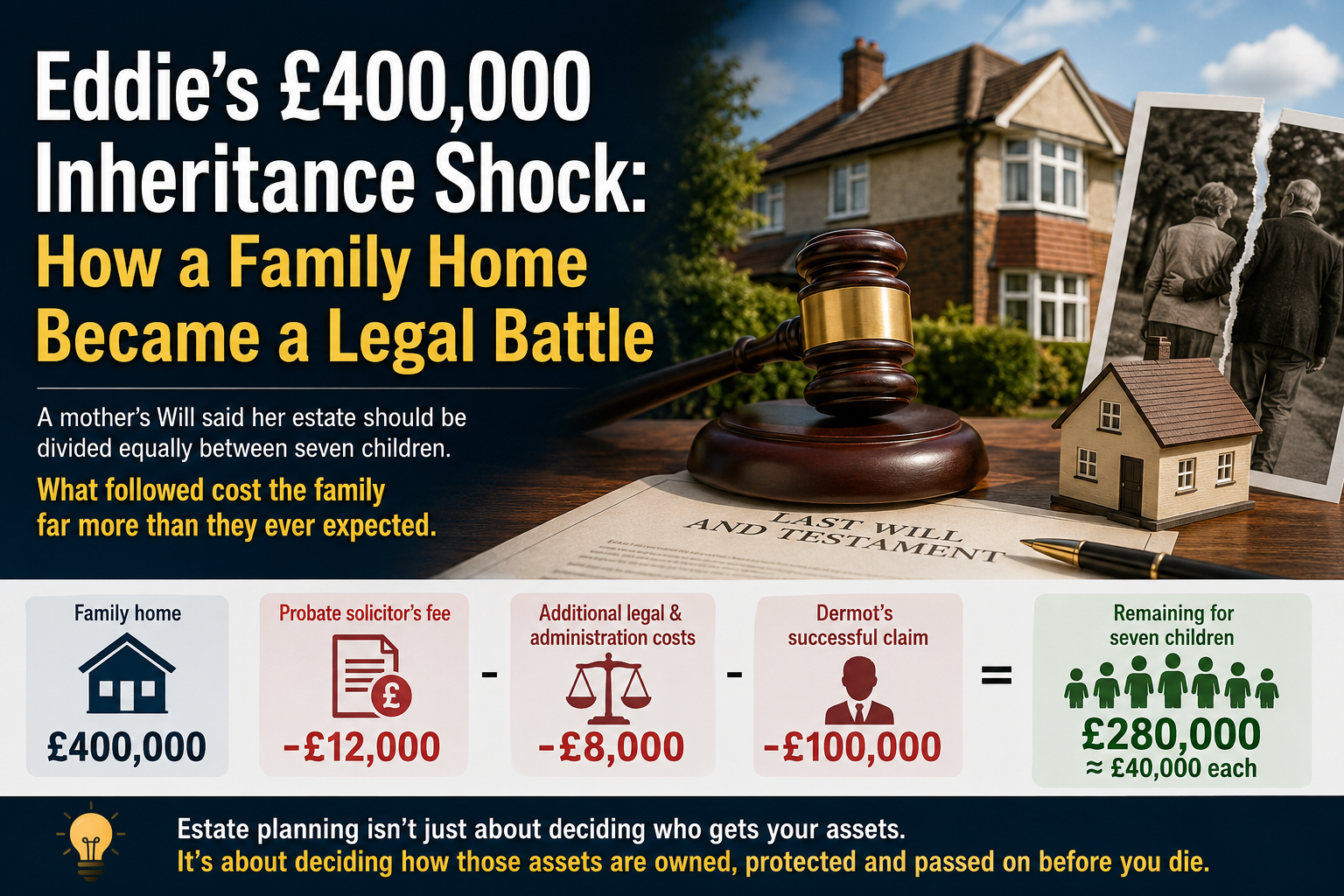
For this fictional example, the figures worked out approximately as follows:
Family home: £400,000
Probate solicitor’s fee: -£12,000
Additional legal and administration costs: -£8,000
Dermot’s successful claim: -£100,000
Remaining for the seven children: £280,000
That left each child with approximately £40,000.
The difference between the original £57,000-per-child expectation and the eventual £40,000 was around £17,000 each.
Across seven children, that is almost £119,000 that the family had originally expected to remain within the children’s inheritance.
And £12,000 of that had gone on the probate solicitor’s fee alone.
What if Mary had planned differently?
It was only after the dispute that Eddie’s family began to understand the importance of estate planning.
Had Mary, while she was still alive, placed the property into an appropriately structured trust for the benefit of her seven children, the situation could potentially have been very different.
The house would have been held by the trustees rather than simply forming part of Mary’s personally owned estate when she died.
Depending on the type of trust and how it had been structured, the property could potentially have avoided forming part of Mary’s probate estate in the same way as personally owned property.
More importantly, in this fictional scenario, Dermot’s successful claim against Mary’s estate would not necessarily have given him the same route to claim £100,000 from the house, because the property would already have been held within the trust.
The seven children could instead have been the beneficiaries of the trust, with the trustees responsible for dealing with the property according to the terms of the trust.
Of course, putting a property into a trust does not automatically make it immune from legal claims or Inheritance Tax. Different types of trusts have different tax and legal consequences, and professional advice would be essential.
But it demonstrates the fundamental difference between simply leaving a property through a Will and considering how that property is owned and protected during a person’s lifetime.
A Will isn't always the whole answer
For Eddie, the experience changed the way he looked at inheritance planning.
“I always thought that if somebody made a Will and clearly said what they wanted, that was it,” he said.
“But we’ve learned that it’s not necessarily that simple.”
A Will is extremely important, but it does not necessarily prevent claims against an estate or resolve questions about ownership of property.
A properly structured estate plan can involve much more than simply writing down who should inherit.
For example, depending on an individual’s circumstances, trusts can sometimes be used to control how assets are held and who benefits from them.
There can also be significant tax considerations.
For the 2026/27 tax year, the standard Inheritance Tax nil-rate band is £325,000, while the residence nil-rate band can provide an additional £175,000 where the qualifying conditions are met, including where a qualifying residence passes to direct descendants.
That means the way an estate is structured can potentially make a significant difference to the amount that ultimately reaches the next generation.
‘Why didn't anyone explain this to us?’
Looking back, Eddie believes his family had concentrated on one question:
"Who gets Mum's house when she dies?"
Perhaps, he says, they should have been asking a different question:
"How should Mum's house be owned before she dies?"
Had the family received appropriate professional estate-planning advice and established a suitable trust while Mary was alive, the £100,000 claim described in this fictional example might potentially have been avoided.
Instead, a house that had cost Eddie’s parents £28,000 became a £400,000 asset at the centre of a legal dispute.
After years of work, waiting and legal costs, each of the seven children ended up with considerably less than the family had originally expected.
For Eddie, the lesson is simple.
Estate planning isn’t just about deciding who gets your assets. It’s about deciding how those assets are owned, protected and passed on before you die.
When Eddie Winn’s mother died, he thought her wishes were perfectly clear. Mary had left a Will stating that her estate should …

Roy and Shirley Sharp. David Mosley. Kath Pearson. Three families. Three heartbreaking stories. One common theme. All found themselves facing the devastating …
A Son’s Story of Dementia, Loss, and a System That Took It All My dad, David Scott, is 62 years old. If …
When a parent first needs care, most families assume one thing: That the NHS will take care of it. It seems logical. …
Christopher Bull from Bedfordshire never imagined his family home would be at risk. Diagnosed with dementia at 76, he assumed—like so many …
When Bob Myers was diagnosed with dementia, his children did what any family would do: they turned to the council for help. …